

Characters
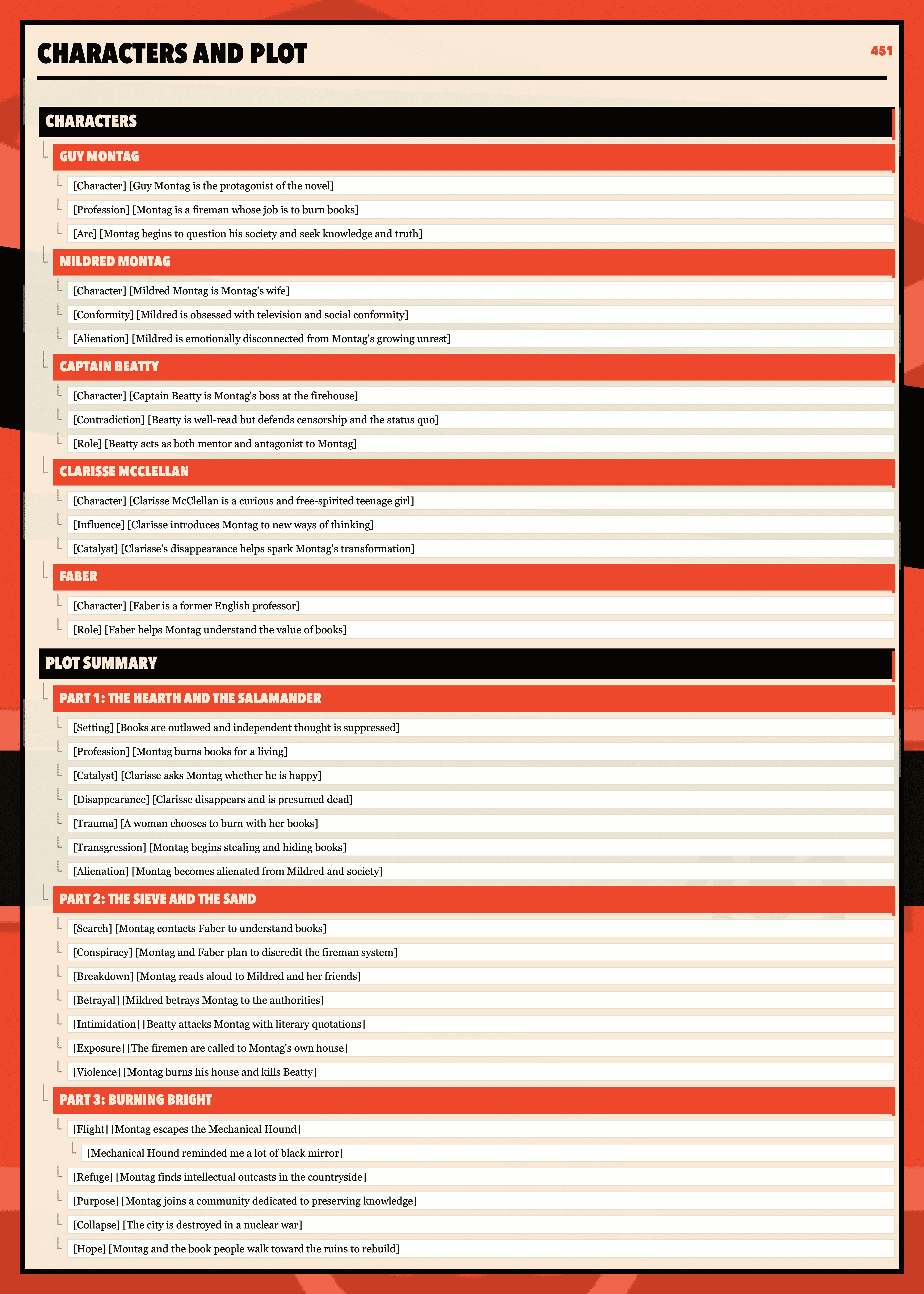
Guy Montag
- [Character] [Guy Montag is the protagonist of the novel]
- [Profession] [Montag is a fireman whose job is to burn books]
- [Arc] [Montag begins to question his society and seek knowledge and truth]
Mildred Montag
- [Character] [Mildred Montag is Montag's wife]
- [Conformity] [Mildred is obsessed with television and social conformity]
- [Alienation] [Mildred is emotionally disconnected from Montag's growing unrest]
Captain Beatty
- [Character] [Captain Beatty is Montag's boss at the firehouse]
- [Contradiction] [Beatty is well-read but defends censorship and the status quo]
- [Role] [Beatty acts as both mentor and antagonist to Montag]
Clarisse McClellan
- [Character] [Clarisse McClellan is a curious and free-spirited teenage girl]
- [Influence] [Clarisse introduces Montag to new ways of thinking]
- [Catalyst] [Clarisse's disappearance helps spark Montag's transformation]
Faber
- [Character] [Faber is a former English professor]
- [Role] [Faber helps Montag understand the value of books]
Plot Summary
Part 1: The Hearth and the Salamander
- [Setting] [Books are outlawed and independent thought is suppressed] In a bleak future society, firemen do not extinguish fires; they start them in order to burn books.
- [Profession] [Montag burns books for a living] Books are treated as dangerous because they contain conflicting ideas and can disturb social happiness.
- [Catalyst] [Clarisse asks Montag whether he is happy] Clarisse's curiosity, reflective habits, and attention to ordinary life awaken something dormant in Montag.
- [Disappearance] [Clarisse disappears and is presumed dead]
- [Trauma] [A woman chooses to burn with her books] Montag is disturbed when a woman chooses death rather than life without books.
- [Transgression] [Montag begins stealing and hiding books] His thefts come from emptiness, curiosity, and the desire to know what books contain.
- [Alienation] [Montag becomes alienated from Mildred and society] His private doubt grows into a broader suspicion of his job and his world.
Part 2: The Sieve and the Sand
- [Search] [Montag contacts Faber to understand books] Faber is initially reluctant but agrees to help Montag learn how to read and interpret literature.
- [Conspiracy] [Montag and Faber plan to discredit the fireman system] Their plan is to reproduce books and plant them in firemen's homes.
- [Breakdown] [Montag reads aloud to Mildred and her friends] The scene exposes the gap between Montag's awakening and the women's conformity.
- [Betrayal] [Mildred betrays Montag to the authorities]
- [Intimidation] [Beatty attacks Montag with literary quotations] Beatty uses his learning cynically to confuse Montag and defend censorship.
- [Exposure] [The firemen are called to Montag's own house]
- [Violence] [Montag burns his house and kills Beatty] Beatty forces Montag to burn his own home, and Montag turns the flamethrower on him.
Part 3: Burning Bright
- [Flight] [Montag escapes the Mechanical Hound]
-
- [Mechanical Hound reminded me a lot of black mirror]
- [Refuge] [Montag finds intellectual outcasts in the countryside] The group, led by Granger, preserves books by memorizing them.
- [Purpose] [Montag joins a community dedicated to preserving knowledge]
- [Collapse] [The city is destroyed in a nuclear war] The destruction represents the collapse of a society that rejected knowledge and truth.
- [Hope] [Montag and the book people walk toward the ruins to rebuild] The ending offers cautious hope that memory and reflection can make a new beginning possible.
Themes and Analysis
Clarisse and Individuality
- [Archetype] [Clarisse resembles a refreshing manic-pixie-dream-girl figure]
- [MYTAKE] [Clarisse has an impact like Coach Carter] Both figures are remembered because they ask questions that shift another person's life.
Education and Indoctrination
-
[Normalization] [The society normalizes absurd arrangements]
-
- [A mother interacting with her children only three days a month]
-
- [Marriage without attachment] Mrs. Phelps says that if her husband dies in war, she is supposed to remarry without grieving.
-
- [Overdoses become routine maintenance] Mildred’s overdose is handled by technicians as an ordinary service call.
-
- [Parlor Walls] [Mildred and her friends immerse themselves in interactive, mindless TV programs on giant wall-to-wall screens] This constant stream of shallow noise prevents people from having quiet time to think, feel, or question authority.
-
- [School System and Play-Vicious Culture] [Children are stripped of reflective learning and instead raised on fast-paced, violent entertainment and sports] Clarisse McClellan is labeled an "anti-social" oddity by her school because she prefers talking, observing nature, and asking "why" instead of "how."
-
- [MYTAKE] [The government's education policy resembles Taleb's suppression of volatility] The state tries to suppress a whole system to eliminate instability, but the suppression ultimately harms humanity.
-
- [MYTAKE] [Handmaid's tale explains how did we get here] “Truly amazing, what people can get used to, as long as there are a few compensations.”
Books and Intellectual Freedom
- [Reading] [Faber explains books as active intellectual experiences] Reading requires active interpretation in a way passive media often does not.
- [Censorship] [People stopped reading partly on their own] The decline of books is not only the result of top-down enforcement.
- [MYTAKE] [The ban on books resonates with modern trivial entertainment] The story is exaggerated, but modern life also contains many forms of entertainment that compete with intellectual pursuits. So books weren't burned literally, but they were in a way as well. In other words, capitalism created alternatives that create so much more shor term dopamine, to the point that there was no need to burn books for people to stop reading them.
- [MYTAKE] [Reading resists uncritical acceptance better than passive political consumption] Consuming commentary on platforms like YouTube can lead people to accept the narrator's opinions too easily.
Distopian aspects
- [Politics] [The elections are a managed farce] The system produces a predetermined result by staging a contest between an obvious loser and an obvious winner.
- [War] [The looming war creates shared ignorance between characters and readers] Both the characters and readers remain partly in the dark about the unfolding conflict.
- [Image] [Bombs falling while people remain in parlors is haunting] The image of people staying oblivious in entertainment rooms while destruction approaches is powerfully disturbing.
-
- [Montag imagining Mildred’s final moments as the city is destroyed] He pictures her absorbed in her television world, facing death without meaningful connection—and finally remembers where they met.
-
- [MYTAKE] [Innefable the emotion of the city destruction]
Miscellaneous Observations
- [Nature] [Country life offers a refreshing escape from indoctrination]
- [Intellectuals] [Professors appear both sexy and dangerous]
- [Symbol] [Old Harvard degrees being hunted shows irrational social vilification] The detail shows how a society can irrationally vilify or revere certain things.
- [MYTAKE] [The ending is unusually optimistic for a dystopian novel] The totalitarian society destroys itself, leaving room for a wiser and more humane world to emerge. For example 1984, ends absurdly badly.
No comments have been added to this post so far, be the first to add one comment!